Diskurs
Dienstag, 24.11.2026
14th International Authors' Rights conference
We create!
Press release regarding the 14th International Authors' Rights Conference organized by the Authors' Rights Initiative on November 9, 2026, at the Academy of Arts in Berlin.
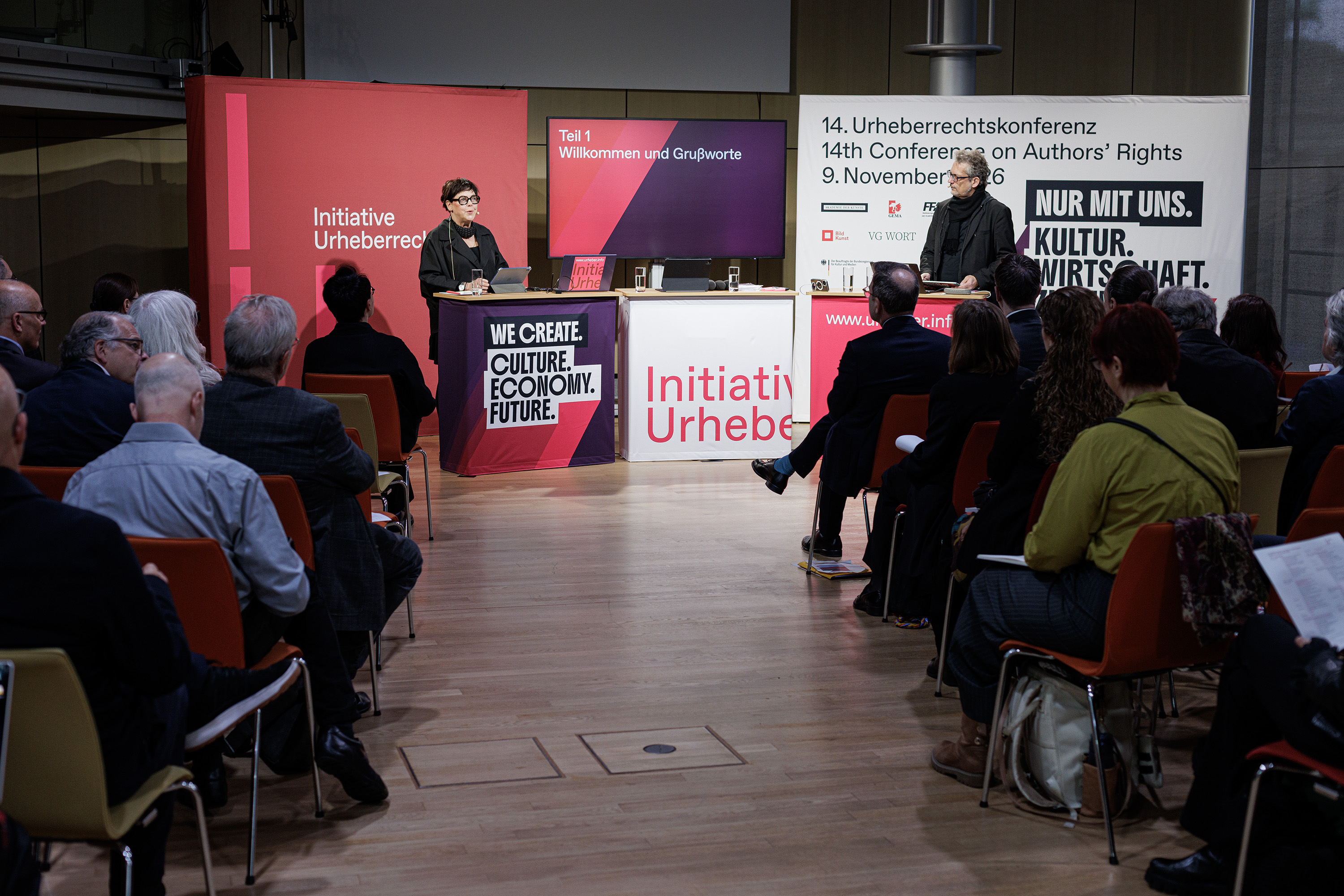
Under the motto “Only with us. Culture, Economy, Future,” the Authors’ Rights Initiative (IU) hosted the 14th International Authors’ Rights Conference on November 9, 2026. Experts from the fields of culture, the creative industries, and media, as well as from academia, the legal profession, and politics, discussed what a fair and sustainable ecosystem for generative AI must look like. High-level political figures were in attendance: Federal Minister of Justice and Consumer Protection Dr. Stefanie Hubig once again delivered the keynote address.
Berlin, November 11, 2026. The conference focused on the theme “Generative AI: The Call for a Sustainable and Fair Ecosystem.” It provided an up-to-date overview from legal, political, media policy, and cultural perspectives. Topics included legislation in Germany, Europe, and the U.S., ongoing court cases, liability and regulation, as well as ethical issues. Around 200 guests attended the event at the Academy of Arts on Pariser Platz, while hundreds more followed the conference via livestream in German and English.
“Legislators must quickly establish a legal framework to strengthen culture, the creative industries, and the media. Some are already saying: to save them. Our conference is intended to contribute to this,” said Katharina Uppenbrink, executive director of the Authors’ Rights Initiative, in the run-up to the event.
A detailed report will follow in the coming days, as more than seven hours of programming—including some highly technical presentations—will require a careful summary. In the meantime, here are some initial impressions and reactions from the political sphere:
In her keynote address, Federal Minister of Justice and Consumer Protection Dr. Stefanie Hubig referred to the rulings by the Munich Regional Court in the cases brought by GEMA against OpenAI and Suno. Although these rulings are not yet final, she noted, they demonstrate that “those who act together win.” At the same time, they highlight gaps in the law, because if a work is not recognizable in the output, there is no basis for enforcing claims related to the training process. The minister expressly endorsed the conference’s call for a sustainable and fair ecosystem: “I share your call.”
Hubig sees the most important lever in Europe, where the Commission plans to propose legislation on AI and copyright next spring. Rights holders must be able to better enforce their existing rights, for example through clear standards for objecting to training data and effective transparency requirements. “Creators also need new rights,” she emphasized. The value created by AI is based on their works, which is why they must share in that value, “on a permanent basis.” Specifically, the Federal Ministry of Justice is proposing a new form of remuneration linked to the generation of AI output in the EU—that is, to where content is generated using AI—regardless of whether individual works are recognizable in the final result. European law would thus apply “because it takes place within the EU.” This is intended to benefit small rights holders in particular, who have no prospect of negotiating licenses with companies.
Dr. Konrad Schmidt-Werthern, a senior official with the Federal Government Commissioner for Culture and the Media (BKM), stated that the current system is unfair and inadequate: “Where third-party content is used, compensation must be paid.” Even from an economic standpoint, he argued, it makes sense to provide fair compensation, because anyone who wants to have good training data in 10 years’ time will need people who can make a living from their work. He announced that the Minister of State would propose at the next Council of Ministers for Culture and Media in Brussels that the EU must act now and that support from the member states is needed. Parliamentary State Secretary Johannes Steiniger (CDU) of the Federal Ministry for Economic Affairs and Energy emphasized that authors' rights are not a niche issue, “but rather a core issue and the foundation of our creative freedom and economic viability.” He spoke out in favor of fair compensation and enforceable claims, and stressed that legal certainty is crucial for all parties involved.
Dr. Carsten Brosda, Senator for Culture and Media of the Free and Hansa City of Hamburg, cautioned against viewing artificial intelligence solely as a technological issue: “Ultimately, AI is yet another manifestation of the platform economy. It also has implications for our democratic culture.” After distribution, he noted, it is now encroaching on the production of creative content and will soon extend to how that content is consumed on end devices. Such a system could function almost entirely without human intervention—and end up running on empty. “It’s still within our power to prevent that.” Brosda supported the new remuneration entitlement proposed by the Federal Ministry of Justice and Consumer Protection and cautioned that those who create and are responsible for cultural works should “not be expropriated just like that, en passant.”
Mareen Fischinger, a photographer and board member of the BFF (Professional Association of Independent Photographers and Filmmakers), shared her perspective from the field. She published her observations from the conference on the BFF forum: “Or Just a Whistle in the Woods?”
Katharina Uppenbrink, who co-hosted the full-day program alongside Matthias Hornschuh, spokesperson for the Authors' Rights Initiative, was pleased with the consensus among the ministries: They all intend to advocate—both nationally and, above all, in Europe—for fair compensation and for the interests of authors, performing artists, and rights holders. The approximately 140,000 creative professionals represented by the IU through its member organizations could take heart again in light of this stance.
“Keep up the pressure,” recommended Marc-Uwe Kling, a co-plaintiff in the lawsuit against OpenAI. Matthias Hornschuh summed it up: “There is agreement that our exclusive right of disposal is non-negotiable. An ‘opt-out’ solution is inappropriate and, given current practice, unworkable. There is also great clarity on another point: We can grant licenses, and we are in a position to make the majority of our repertoire available in this way. A prerequisite for this—and by no means an obstacle—is a return to the protective purpose of copyright law, which, in its European form, was never purely a right of exploitation, but rather serves to protect personality rights and innovation.”
Watch the entire conference here: https://urheber.info/conference-2026
PowerPoint presentations: https://urheber.info/konferenz-2026 (downloads)
PHOTOS: (© Gezett_IU // Captions are available upon request)
Author's Rights Initiative
Through its more than 40 member organizations, the Authors' Rights Initiative represents the interests of approximately 140,000 authors and performing artists in the fields of fiction and nonfiction, visual arts, journalism, design, music, audio and audiovisual media, photography, illustration, acting, game development, dance, and many more: About us | Initiative Urheberrecht
Contact:
Katharina Uppenbrink
Managing Director
Authors’ Rights Initiative
+49 160 9095 4016
Email: katharina.uppenbrink@urheber.info
Website: www.urheber.info
The event was supported by the Academy of Arts, the Federal Government Commissioner for Culture and the Media, the FFA, GEMA, VG Bild-Kunst, and VG Wort.
Pressekontakt: info@urheber.info
Mehr Diskurs
Montag, 23.11.2026
NewsSchutz des Urheberrechts im KI-Zeitalter
14 EU-Staaten schließen sich deutscher Initiative an
Auf Initiative Deutschlands haben sich 14 weitere Mitgliedstaaten, darunter Frankreich, Polen und Spanien, an die Europäische Kommission gewandt, so bald wie möglich einen Legislativvorschlag zur Stärkung des Urheberrechts im KI-Zeitalter vorzulegen.
Weiterlesen